
Freeport Resident Lookup Coverage
Freeport has no official all-resident roster. Instead, each source confirms one dated relationship: assessed owner, deed party, registered voter, court party, family event, licensed professional, business officer, or historical subject. State and county keepers set separate search rules.
| Record | What It Confirms | Where to Search | Access |
|---|---|---|---|
| Assessment | Owner/addressee, situs, mailing clue | Devnet and assessor | Free current roll; not title or occupancy proof |
| Voter registration | Registration match and civic geography | Illinois voter lookup | Required identity fields and use limits |
| Court record | Party role, case, and docket event | Circuit Clerk and Judici | CAPTCHA and sealed-record limits |
| Vital or genealogy | Birth, death, or marriage event | County, IDPH, library, IRAD | Eligibility, purpose, and age thresholds |
| Business or license | Filing role or credential status | Illinois SOS, IDFPR, ISBE | Public role search; not home-address proof |
Begin with the source that fits the question. An address points toward the assessor. A professional role points to the state license office. An old family name belongs first in the library. Record the screen's update date and access limits.
Match Freeport Names Carefully
A reliable resident lookup uses a person, place, and time key. Write down the full name, middle initial, aliases or spelling variants, then connect it to a situs address, mailing address, parcel, ZIP, business, cemetery, or court. Finally, note the assessment update, filing date, directory year, or event date. A same-name hit with no shared place and time stays unresolved.
- Keep maiden and married names separate until a source joins them.
- Distinguish a business address from a home address.
- Do not treat a mailing address as the property's physical situs.
- Write “not located in the source searched” instead of claiming no record exists.
The PTAX sample in the research shows why: a 620 E Iroquois site and 1015 S Oak mailing address appear in the same assessment context. Combining those fields would produce a false residence claim.
Confirm Freeport Voter Registration
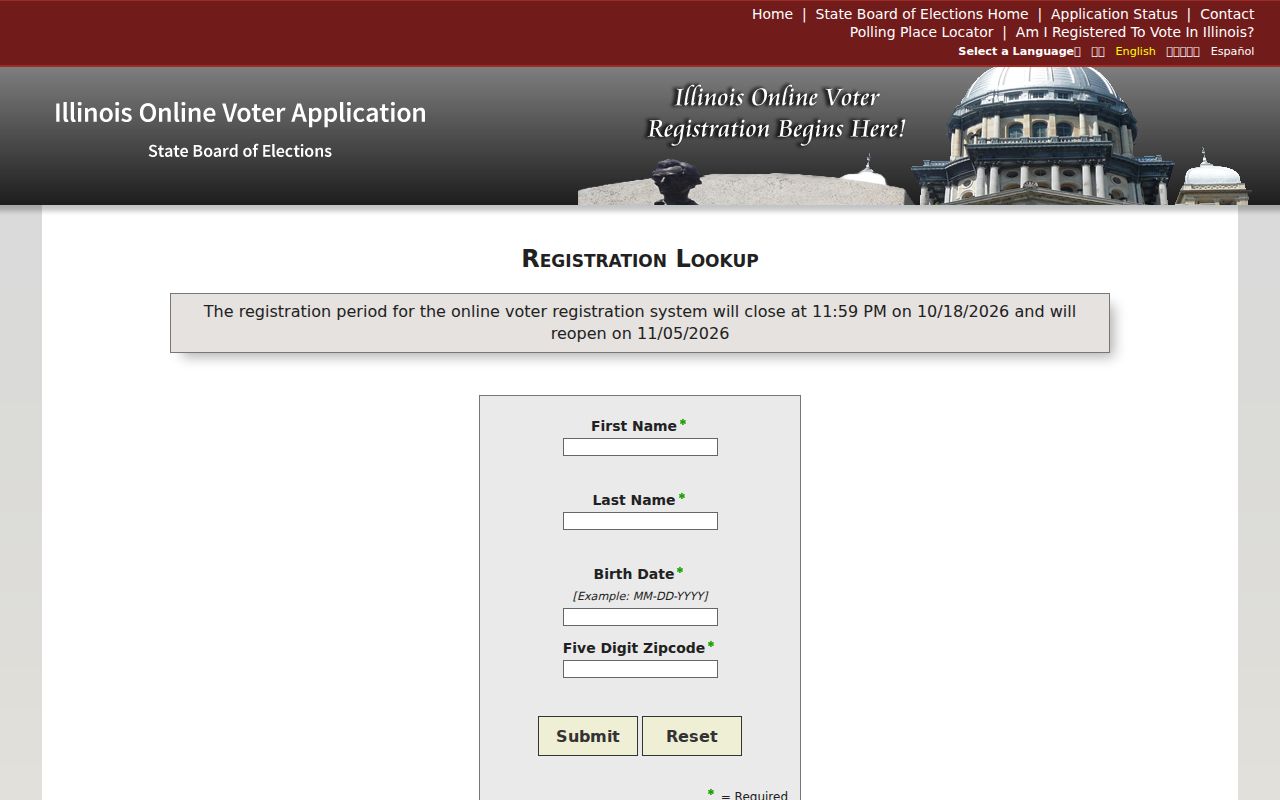
The Illinois Online Voter Registration Lookup uses two stages. The first asks for first name, last name, birth date, and ZIP. A match then requires street number and street name. The lookup can confirm a registration relationship, not citizenship, private contact details, or current presence at a house.
| Lookup stage | Fields | Meaning |
|---|---|---|
| Identity | First name, last name, birth date, ZIP | Narrows the registration record |
| Address check | Street number and street name | Tests the address held for registration |
| Local follow-up | Ward or precinct map | Supplies election geography, not occupancy |
The captured official form displays the actual first-stage fields for a Freeport resident lookup.
Use the form only for lawful civic research. Illinois restricts commercial solicitation and business use of voter information.
Check Freeport Court Names
The Stephenson County Circuit Clerk routes civil, criminal, traffic, family, probate, archive, and appeal questions. Its phone menu sends traffic to option 1, criminal to 2, civil to 3, and jury, archives, or appeals to 4. The linked Judici route presented hCaptcha during research, so it should not be described as an unrestricted name index.
Judici's FAQ states that Stephenson criminal and civil files are current from 1989 and excludes juvenile, adoption, and impounded cases. If the portal blocks a search, call 815-235-8266 or visit the second-floor counter at 15 N Galena Avenue during weekday office hours. Give a name variant, date range, case category, and likely party role. Ask about inspection, an ordinary copy, or certification.
| Identity | Exact party name and role |
|---|---|
| Placement | Court, division, case number, and case type |
| Timing | Filing, docket event, order, or disposition date |
| Access | Public document, redaction, seal, CAPTCHA, account, or fee |
Do not merge a court party with a property or directory name until an independent address, date, role, or document resolves the match.
Verify Freeport Resident Records
The strongest one-person check preserves what each record actually says. An assessment addressee is not necessarily an occupant. A deed grantee is tied to a transfer. A voter is tied to registration. A court name is tied to a party role. Use two records whose name, place, and time overlap.
- Search the Devnet assessment roll by owner name or site address and record the PIN, situs, mailing clue, and update date.
- Confirm parcel geometry in WinGIS, treating its map label as a clue rather than title proof.
- Use the Recorder route for grantor, grantee, date, legal description, PIN, or document type; ask at the counter for older material.
- Check the relevant voter, court, vital, license, or historical index using the same spelling and date range.
- Order a certified copy from the custodian only when that formal copy is needed and the requester qualifies.
- Docket
- The court's dated list of filings, hearings, and orders in a case.
- Index versus image
- An index points to a record; an image reproduces the underlying document and may have different access.
- Certified copy
- An official copy carrying the custodian's authentication, often subject to eligibility and a fee.
For older material, the Freeport city directory collection can connect names with dated addresses before census, cemetery, or newspaper checks.
Freeport Vital Record Checks
The Stephenson County vital-record pages route birth, death, and marriage copies, while divorces belong with the Circuit Clerk. Birth access is limited to the adult subject, parent, guardian or legal representative, or a court-authorized requester. Illinois genealogy access generally begins after 75 years for births and 20 years for deaths, with separate archival thresholds.
Historical researchers also have a non-certified library path: Stephenson microfilm covers births from 1878 to November 4, 1918, marriages from 1837 to December 29, 1940, and deaths from 1878 to December 27, 1968. Counter, mail, county online routing, IDPH forms, library microfilm, and IRAD each serve a different date or copy need. Verify eligibility and current fees before sending identification.
Freeport License Role Lookup
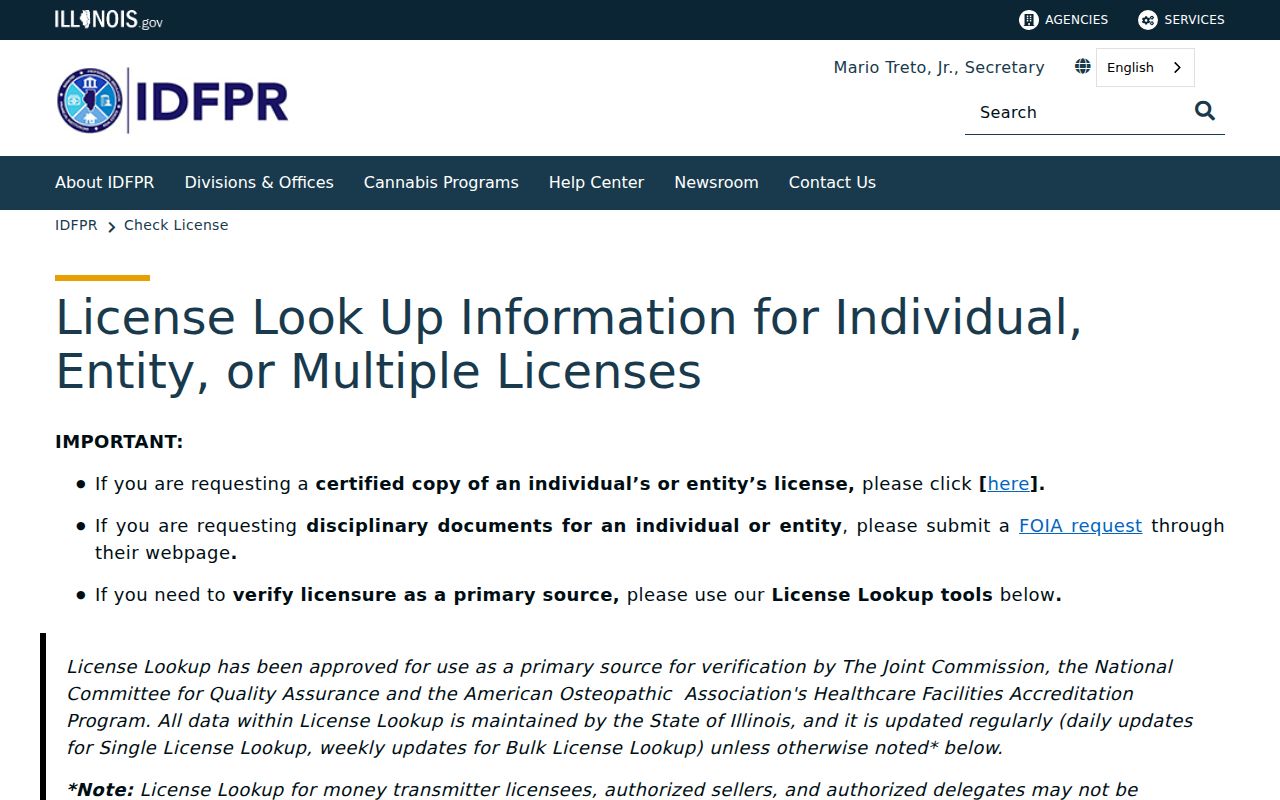
The Illinois professional license lookup searches individuals, entities, and multiple licenses. Single-license data refreshes daily, bulk data weekly, and the agency advises allowing a day after issue. Educator credentials use ISBE ELIS, while corporations and registered roles use the Secretary of State business search. Each result confirms a dated role, not a home.
The captured IDFPR screen documents this official route for a Freeport resident lookup.
Copy the license type, status, dates, and source update. Use the separate discipline route only when it is relevant to the precise record question.
Freeport Lookup Offline Routes
A blocked or incomplete portal does not prove no record exists. Call the named custodian, visit the counter, send a narrow mail request, ask the library or archive for a dated volume, or use the Illinois Freedom of Information Act for non-confidential administrative records. FOIA does not override vital-record limits, sealed cases, protected addresses, or other confidentiality laws.
Keep a request log with the date, office, record description, delivery method, fee estimate, redaction basis, and response. That record prevents repeated pressure on a small office and distinguishes a legal denial from a technical failure.
Match the request to the custodian. The County Clerk and Recorder holds deeds, elections, marriage, and many vital-record routes. The Circuit Clerk holds trial-court, probate, and court-file material. Freeport city departments answer for their own permit, license, and administrative files. IRAD preserves selected older county and municipal series, while the library holds non-certified research copies and indexes. Asking the wrong office can look like a failed resident lookup when the record simply belongs elsewhere.
Protected Freeport Resident Addresses
The Illinois Address Confidentiality Program lets qualifying survivors use a substitute address for new state and local public records. It does not automatically remove old property records. Never triangulate a protected location from adjacent sources or republish the substitute as if it were an ordinary residence.
The program page shown below explains the safety boundary behind this resident lookup limit.

Direct questions to the program at 1-844-916-0295 instead of contacting or trying to locate the protected person.
Freeport Resident Lookup Limits
Illinois FOIA access is not blanket permission to republish personal data. Voter-file rules, the Vital Records Act, sealed and juvenile court rules, the federal motor-record privacy law, and the Address Confidentiality Program all limit disclosure. Ask the custodian to correct a wrong source record, and describe a negative search by its exact source and date rather than claiming a person has no record.
Lawful use. A Freeport resident lookup is for lawful personal and civic research. Never use a record to stalk, harass, intimidate, or expose a protected person.
Use the least personal detail needed to support the finding. A source name, record type, date, and verification status are often enough.
Commercial search products may combine old and mismatched data without showing the responsible keeper. Official sources are narrower, but their limits are visible and their errors can be taken back to the office that maintains the record. Compare categories rather than assuming a large result set is more accurate. For family history, heirs, reconnecting with consent, consumer safety, property curiosity, and civic transparency, a dated official record plus one independent source is a stronger basis than an unexplained compiled profile.
Illinois stalking law addresses repeated conduct that causes reasonable fear or emotional distress, including surveillance and unwanted contact. Stop a search when it shifts from confirming a public relationship to tracking a private person's movements. Do not publish an exact home address, phone, email, protected location, sensitive vital fact, or sealed detail merely because some source exposed it.