
Freeport City Directory Shelf
The Freeport Public Library special collections are the main local shelf. The library describes city directories from 1857 to the current era with missing years, while another catalog line gives 1861 through 2023. Ask about a specific year before traveling. No complete open digital run was found, so access centers on the Frances Woodhouse Local History Room, staff or Genealogical Society volunteers, and page-level citations.
| Freeport collection | Date span | Keeper | How to use it |
|---|---|---|---|
| City directories | 1857 to current, with gaps | Freeport Public Library | Local History Room; verify volume and page |
| Telephone directories | 1956 to current, with gaps | Freeport Public Library | Room use; no full-text portal located |
| Newspaper microfilm | 1856 or 1858 to 1919, title-specific | Library and Illinois Newspaper Project | Microfilm, surname index, partial OCR |
| County archives | 1837 to 1977, series-specific | IRAD at Northern Illinois University | Catalog and repository request |
Publishers changed often. A Martin's Block history names Hall & McEvoy in 1857, Umberhine & Gustin in 1861, several publishers in the 1870s, and Freeport Directory Co. or W.H. Wagner & Sons in 1898–99. Those names anchor dates, but they do not prove that every annual volume survives.
Freeport Directory Research Room
The Frances Woodhouse Local History Room is on the library's first floor at 100 E Douglas Street. Its 4,500-plus volumes and files make it far more than a directory shelf. A Stephenson County Genealogical Society volunteer helps with surname files, family books, local histories, maps, microfilm, cemetery work, and school yearbooks. Call 815-233-3000 first because volunteer coverage can change.
The room also holds about 500 family-history volumes and personal-name Vertical Files. Give staff a surname, approximate date, street, and record type. A file's presence does not prove that it covers every person of that name.
The library's collection inventory shows the choices available for Freeport city directory research.
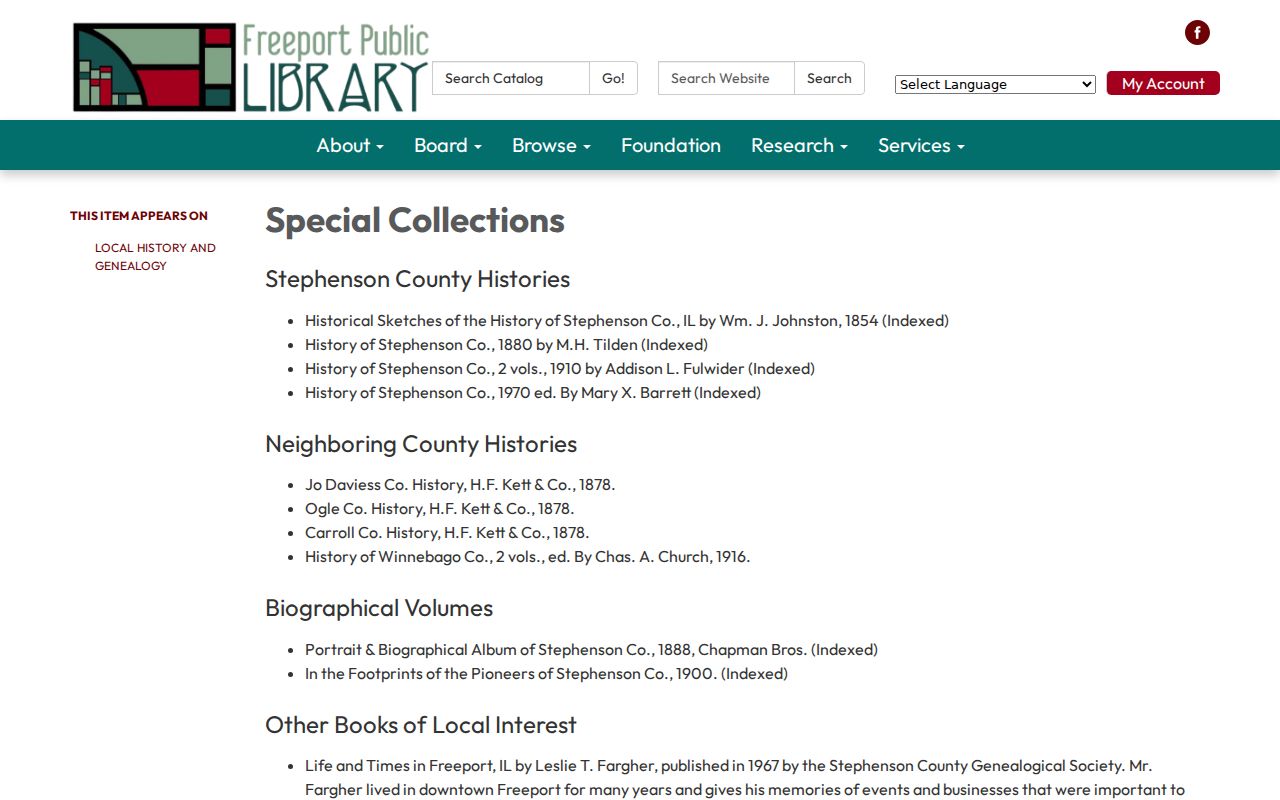
The captured page helps researchers choose directories, files, maps, or yearbooks before calling the room.
Decode a Freeport Directory Entry
No open page image was captured for the local run, so do not presume every volume uses the same marks. Copy the entry exactly. Note the abbreviation key, directory year, publisher, page, and whether the list is alphabetical or arranged by street. A short line can hold several distinct facts, each tied only to that publication date.
| Person | Name, initials, spouse, or relationship wording exactly as printed |
|---|---|
| Work line | Occupation and employer, if the volume prints them |
| Place | House number and street as written in that year |
| Status mark | Owner, renter, boarder, or widow notation only when the key defines it |
| Citation | Year, publisher, page, section, and repository |
- Criss-cross section
- A section arranged by street and house number rather than surname.
- Householder index
- A list centered on a household's named person, with scope set by the publisher.
- Abbreviation key
- The volume's guide to shortened words and symbols. Read it before expanding a mark.
Compare the address with the same year's map or paper. A work address, boarding mark, or business listing is not a home address without another source.
Freeport Names Between Volumes
The library newspaper collection bridges directory gaps with separate titles, not one seamless run. Surname files index births, deaths, marriages, anniversaries, biographies, news, and businesses. Freeport Daily Journal material begins in 1856, the Weekly Bulletin in 1858, and other runs overlap through the early twentieth century. Retain the title, issue date, page, and notice type.
The newspaper page shows why microfilm remains central to Freeport city directories and family research.
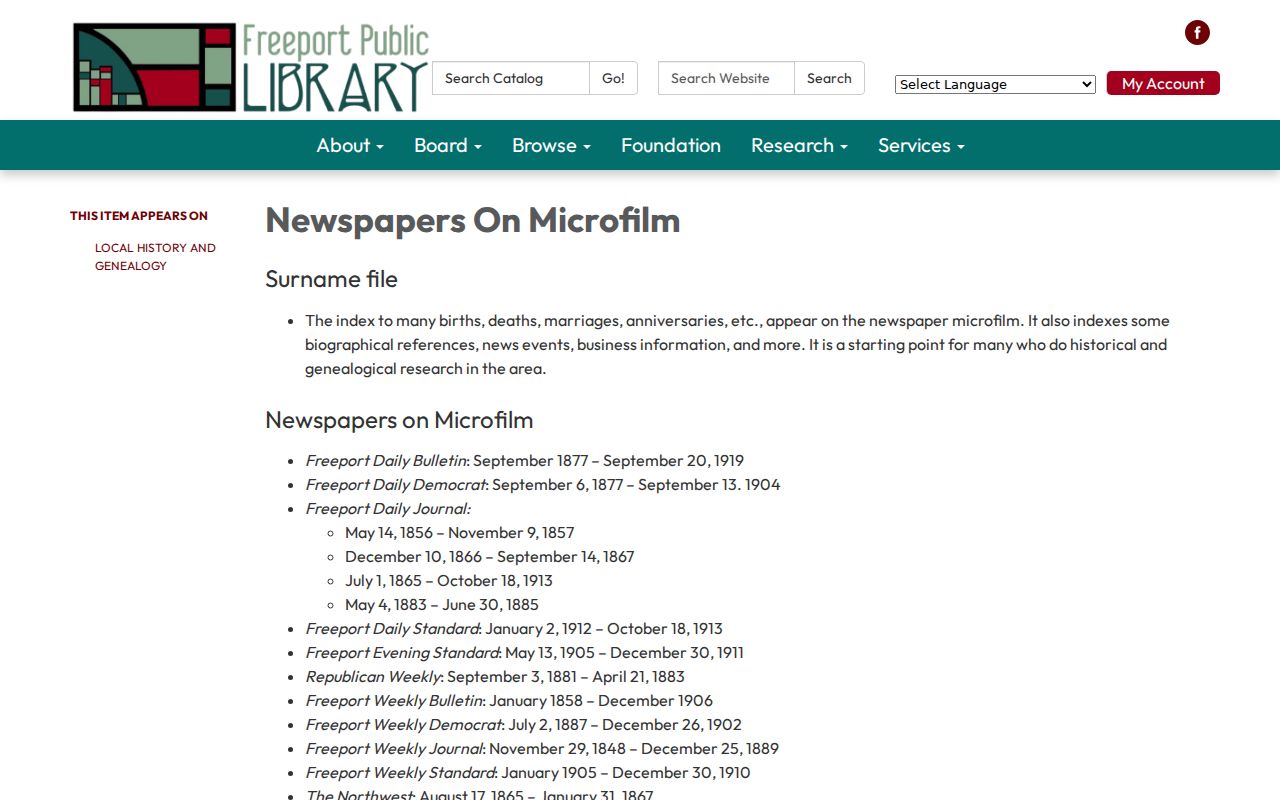
Use the surname-file lead first, then inspect the issue. OCR can miss initials, broken type, and uncommon spellings.
Freeport Directory Trail Endpoints
When a person disappears from a city directory, do not assume death or a move. Search the next available volume, then check newspapers and library cemetery records. Coverage includes Freeport City Cemetery, Oakland, Chapel Hill, and many Stephenson County township cemeteries. Society work added children's names and refreshed main cemetery volumes.
The cemetery page documents Freeport holdings and useful neighboring-county material.
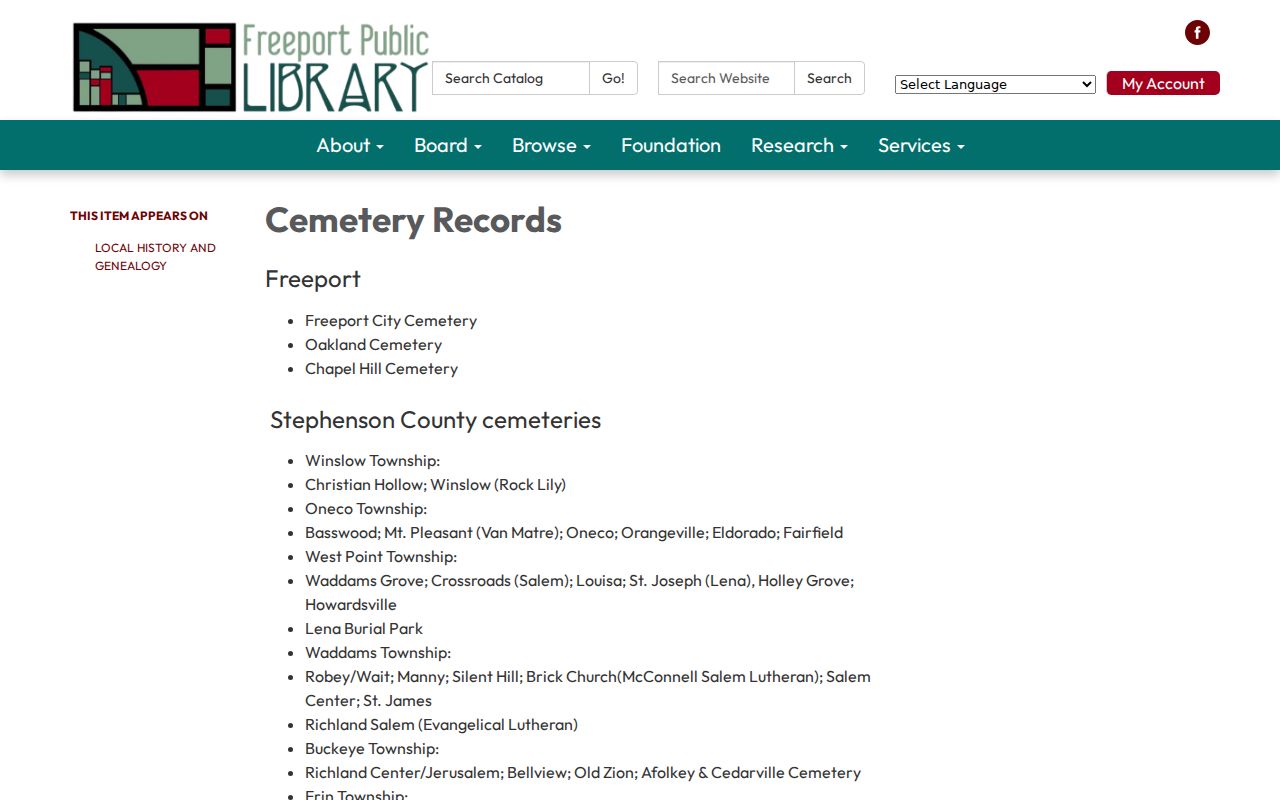
A cemetery record may close a trail, but check the transcription or image against a death notice or vital record.
Freeport Museum Directory Clues
The Stephenson County Historical Society resource library at 1440 S Carroll Avenue adds books, documents, photographs, and business or school history. The collection has grown since 1944. It is public by appointment, and cataloging remains in progress, so send a narrow question rather than expecting a full online catalog.
The museum resource page states its appointment and catalog status.
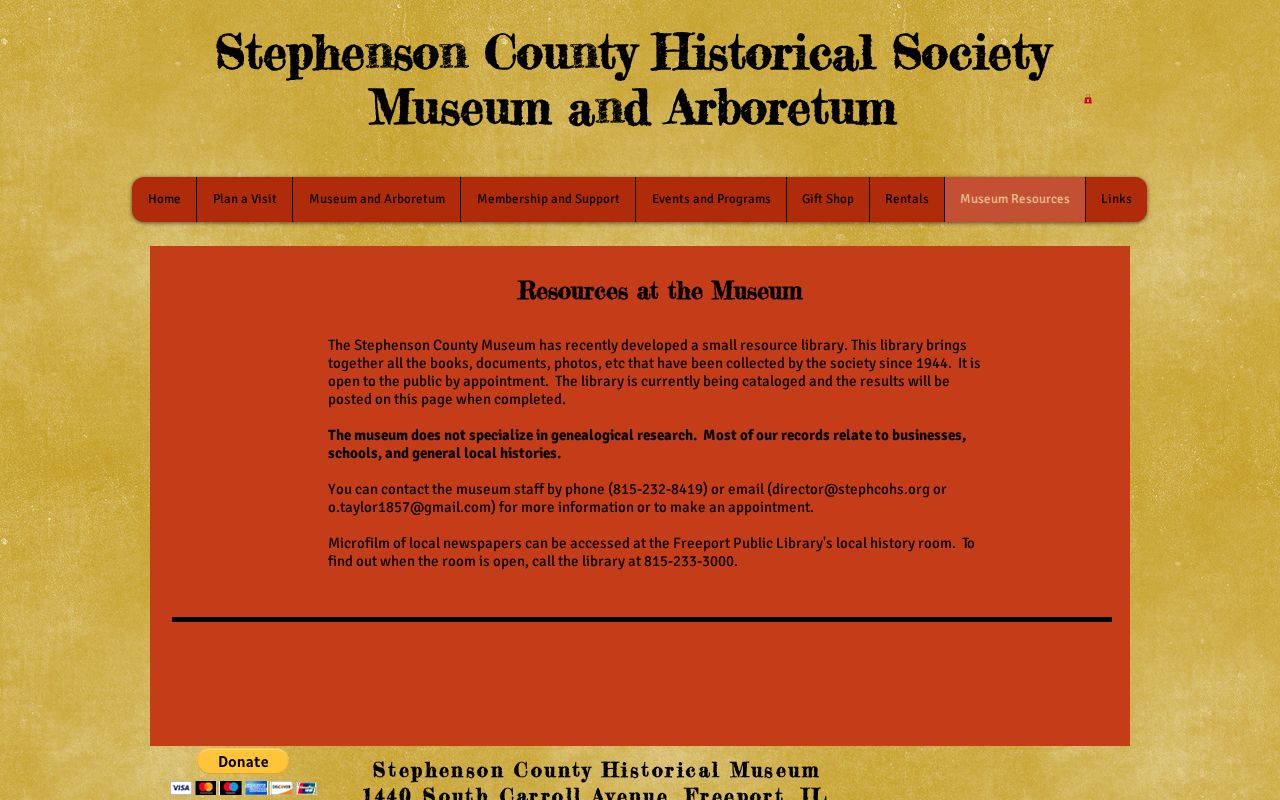
Photos and business files can explain an entry when a listed firm or school no longer appears on a modern map.
Freeport Lives Beyond Directories
Local works add people whom a standard city directory may describe poorly or omit. The library holds Early Black Settlers of Stephenson County, 1830–1930, Civil War regimental histories and rolls, Freeport Debate sources, county histories, and the Micro Switch newsletter Micro News from 1940 through 1985.
School yearbooks add another bridge. Freeport High School's Stella starts in 1896 and continues with gaps; Aquin and other school runs are less complete. Such sources can confirm a class, unit, organization, or civic setting, but each claim still needs a date and page.
Freeport Directory Archive Bridge
The local shelf does not hold every record needed to explain a household. The Illinois Regional Archives Depository listing for Stephenson County supplies an older government layer at Northern Illinois University. Its catalog includes a deed index from 1837 through 1938, deed records through 1962, marriage licenses from 1837 through 1926, death certificates from 1878 through 1954, burial and removal permits from 1849 through 1910, and several short probate series. Freeport election papers from 1946 through 1967 also appear in the catalog.
Use IRAD after a city directory supplies a name, year, or address. Search the archive catalog by county and record series, then give repository staff the narrowest date span possible. An index citation may point to a book or file, but it is not the full record. Ask whether a copy comes from an index, an original volume, microfilm, or another reproduction. The repository is at Founders Memorial Library in DeKalb, so phone or written contact may save a trip.
Older property work also changes vocabulary. Early deeds tend to rely on book, page, and legal description, while modern systems lean on parcel numbers and street addresses. Preserve both forms when a Freeport directory address becomes the bridge between them.
Cite Freeport Directory Findings
A reusable directory note should let another person locate the same entry. Record the person as printed, the year, exact title, publisher, page, repository, and section order. Add the abbreviation key when a mark affects the meaning. For a newspaper follow-up, record the title, issue date, page, and notice type. For a cemetery volume, identify whether the evidence is a transcription, an image, or a later update.
Research can then distinguish three kinds of evidence. A city directory is a dated publication. A county deed or vital record is an official record with its own access rules. A local history or Clio entry is a secondary account that should lead back to cited sources. The Martin's Block account, for example, identifies Deed Book P, Volume P-284, pages 194–195 and a street-number shift. Those details are strong leads, yet the underlying deed and directory pages remain the best proof.
For remote help, send the library or historical society one focused request. Include the surname, spelling variants, rough year, street, collection type, and question. Ask for the volume and page even if staff sends a transcription. This small citation habit keeps two people with the same initials from becoming one person in family notes.
Save negative findings with the same care. State which Freeport city directory year was checked, whether that volume was complete, and which spelling was used. Then try initials, a spouse's name, the former street number, and the nearest available year. A clear negative note is useful evidence about the search, even though it cannot prove that the person was absent from Freeport.
Trace Freeport Families by Year
A sound Freeport city directory trail moves one year at a time. Every entry stays tied to its date. The Freeport resident lookup can test a later name against current official indexes without treating an old address as current occupancy.
- Start with the closest known directory year and copy the full entry plus its citation.
- Move both ways through available years, noting names, initials, occupations, spouses, and moves.
- Check a street-arranged section only when that volume includes one.
- Pair the trail with census years, maps, plats, newspaper notices, and yearbooks.
- Use cemetery, funeral, probate, or vital records to test why a listing ends.
A missing entry may reflect a shelf gap, publisher rule, changed surname, move, death, or street renumbering. The Martin's Block trail shows the risk: 108 Stephenson Street became 14 W Stephenson about 1921. Search both forms and wait for a second source before choosing an explanation.
Note: Ask staff to confirm the exact Freeport volume before visiting because the stated directory ranges include missing years.