
Freeport Previous-Resident Sources
Freeport's backward trail stretches from current parcel systems to nineteenth-century county books. Begin with the source nearest the period in question. Current work starts with the assessor and Recorder. Older work shifts to the library and the Illinois Regional Archives Depository at Northern Illinois University.
| Source | Documented years | Keeper | Address-history value |
|---|---|---|---|
| IRAD deed index | 1837-1938 | NIU IRAD | Grantor, grantee, and book/page lead |
| IRAD deed record | 1837-1962 | NIU IRAD | Recorded conveyance series |
| Freeport city directories | 1857-current, with gaps | Freeport Public Library | Listed names, addresses, and occupations by year |
| Telephone directories | 1956-current, with gaps | Freeport Public Library | Subscriber and address clues |
| Federal census microfilm | 1820-1930 locally | Freeport Public Library | Household names, ages, places, and relationships |
| Sanborn Freeport maps | July 1910 | Library of Congress and UIUC | Block and building-footprint context |
Building and zoning records add work at an address, but their start dates were not shown. They may name an applicant without naming all past residents. The best result is a dated chain in which deeds explain ownership, directories or census schedules explain households, and maps confirm the same physical place.
Freeport Records Since 1837
Stephenson County was established on March 4, 1837. The IRAD Stephenson catalog reaches into that founding era with deeds, marriages, probate, tax, vital, election, assessor, and municipal series. This is the key numerical frame for Freeport previous residents whose trail predates the online index.
The county's nineteenth-century start does not mean each series is complete. Birth certificates in the catalog run 1855-1903, death certificates 1878-1954, and marriage licenses 1837-1926. Burial and removal permits cover 1849-1910. Record the series title and its range before drawing a conclusion from a missing name.
Note: A missing online result may mean the correct record is in an older book, not that the event never occurred.
Trace Stephenson County Deeds
A deed chain follows transfers, not every person who lived at the site. Start at Devnet wEdge, which searches owner name, parcel number, house range, street, and city. Save the PIN, site address, legal clue, and current update date. The assessment page warns that its data is not a title determination.
- Find the present assessment record by site address. Copy the PIN and spelling of the listed owner.
- Search Tapestry for that owner's acquisition deed, using name, date, document type, PIN, or legal description.
- Read the transfer for the seller, who is the grantor. Search that seller as a prior grantee to locate the earlier purchase.
- Repeat the link. Record document number, date, book/page, legal description, and each spelling change.
- For records outside the generally post-July-1992 online range, contact the Recorder or move to the IRAD index and deed books.
- Grantor
- The party conveying an interest in the recorded instrument.
- Grantee
- The party receiving the recorded interest.
- Chain of title
- The linked sequence of transfers for the same land.
- Legal description
- The lot, subdivision, or metes-and-bounds text that can survive a street-number change.
The online fee displayed during research was $8.95 per search, $2 for the first printed page, and $1 for each added page. An older county PDF showed different figures. Check the live screen before paying. The Recorder at 50 W Douglas Street, Suite 500, is the in-person fallback, and the office can be reached at 815-235-8289 for current copy rules.
Freeport Library Address Trail
The Freeport Public Library genealogy collection supports address history through city directories, census microfilm, probate indexes, and non-certified vital-record microfilm. The Frances Woodhouse Local History Room is on the first floor at 100 E Douglas Street. Call 815-233-3000 extension 214 to confirm volunteer help and hours.
The image below records the library's genealogy route. No separate online house-history guide was found, so arrive with a full address, surname, date range, and the exact type of record needed.
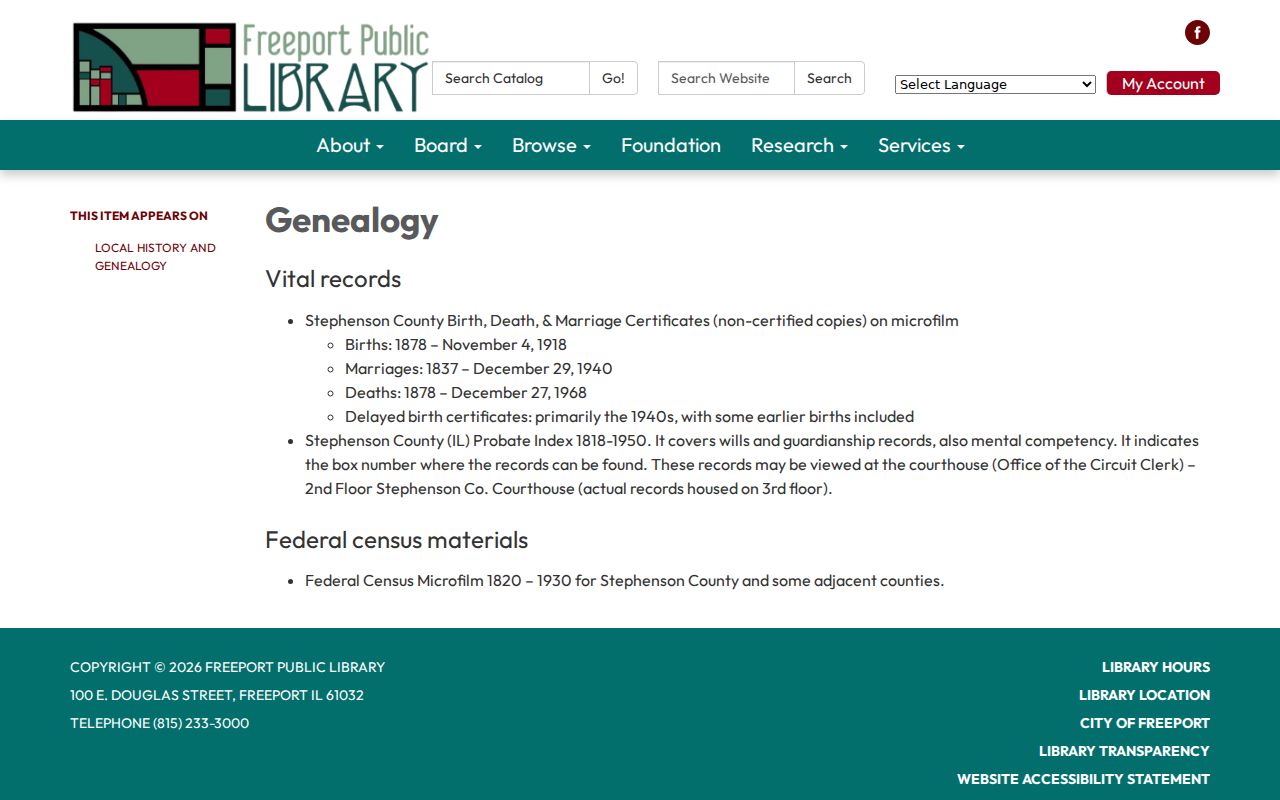
The library source bridges missing directory years with census, probate, newspaper, and vital microfilm rather than promising one complete address index.
When Freeport Street Numbers Changed
The Martin's Block history gives a precise local warning. A building cited as 108 Stephenson Street in late nineteenth-century material became associated with 14 W Stephenson after renumbering about 1921. The local history entry also points to deed Book P, Volume P-284, pages 194-195.
Before deciding that a family moved, compare the old directory entry with the parcel's legal description, the 1910 map sheet, and later street numbering. Search both forms in newspaper indexes. The address transition can be the finding, not an error. It also explains why name-first and address-first searches may reach different results for the same place.
Note: Preserve the exact address printed in each source, then add the modern equivalent as a separate research note.
Freeport's 38-Sheet Map
The Library of Congress Freeport Sanborn set dates to July 1910 and contains 38 sheets. It is not a resident roll. It can confirm block position, building footprint, lot context, and mapped use at that date, which helps test whether two street references point to the same structure.
Find the index sheet first. Then locate the street, block, and footprint. Pair the map with a directory year close to 1910 and with a deed legal description. Do not read an occupancy label as the name of every household member.
Freeport Newspaper Name Trails
Freeport newspaper research is title-specific. Runs include the Daily Bulletin, Daily Democrat, Daily Journal, Daily Standard, Evening Standard, Republican Weekly, Weekly Bulletin, and Weekly Democrat, with discontinuous coverage beginning in 1856 or 1858. The library surname-file index can catch names that weak optical character recognition misses.
The Illinois Newspaper Project search identifies holdings and offers a wider OCR route. Its successful capture appears below.
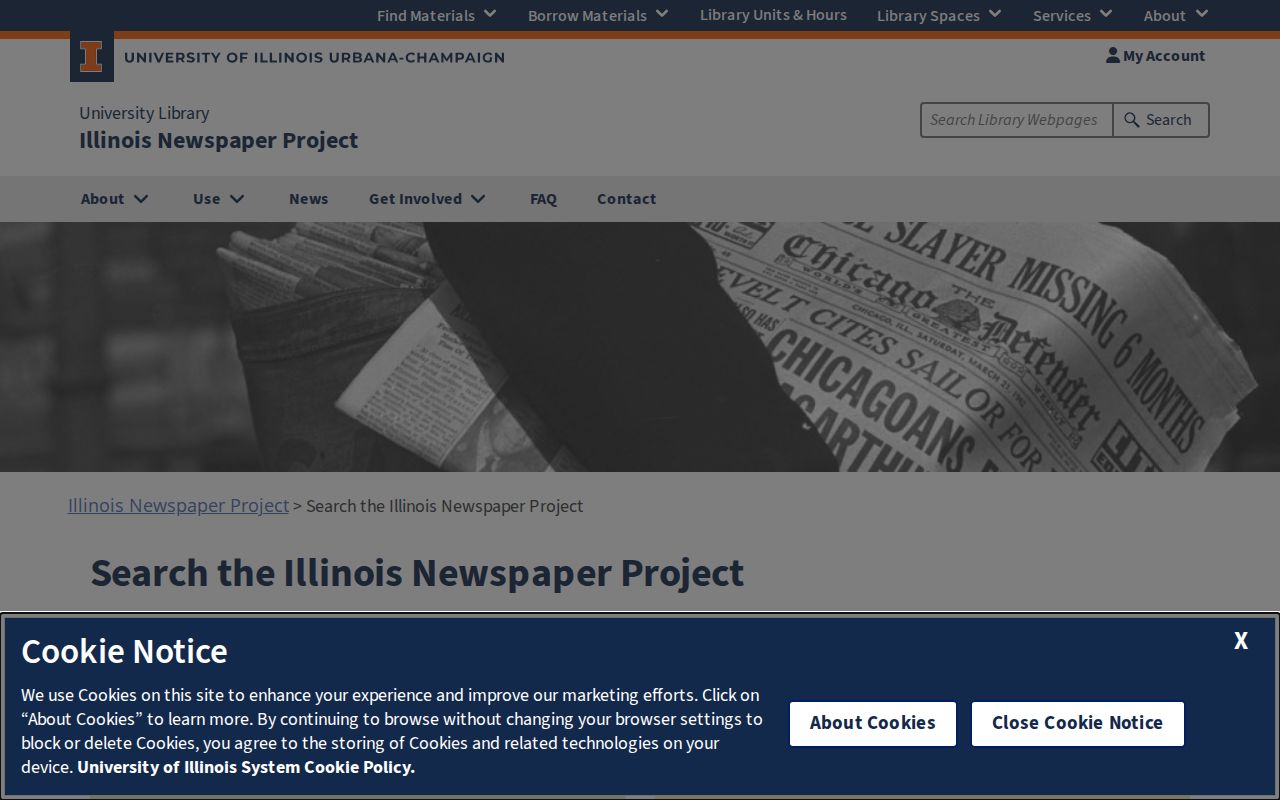
Use an obituary, property notice, or social item as a dated clue. Confirm the person against a directory, probate box, cemetery entry, or deed before adding the name to an address chain.
Request Freeport Address Records
Online searching is only one access channel for previous residents. For a post-July-1992 deed, Tapestry is the first remote route. If the image or index is missing, contact the Stephenson County Clerk and Recorder at 50 W Douglas Street, Suite 500, Freeport. The office accepts questions by phone at 815-235-8289 and through its published county email contacts. Ask for the index entry, document number, book and page, or certified-copy procedure tied to a defined parcel.
Earlier deed work belongs in the counter books or IRAD series. Northern Illinois University IRAD is in Founders Memorial Library, Room 245B, in DeKalb, and lists 815-753-1807. A useful request gives the grantor or grantee spelling, a rough year, the legal description or book/page lead, and the specific series. Staff should not be asked to perform an unrestricted search for a living person.
The library route is different. Freeport Public Library holds directories, telephone books, census microfilm, probate indexes, local vital microfilm, newspapers, surname files, cemetery material, plats, and maps. The Stephenson County Historical Society resource library at 1440 S Carroll Avenue adds photographs, books, documents, and business or school history by appointment. Its cataloging is still in progress, so a narrow question and a known date make a visit more productive.
Recorder counter
Use for older instruments, missing online copies, index help, and current certified-copy rules.
NIU IRAD
Use for the 1837-1938 deed index, the 1837-1962 deed record, and other older county series.
Local History Room
Use for listed households, census links, newspapers, probate leads, maps, and address changes.
Mail, email, phone, and in-person requests should preserve the same audit trail. Note the date sent, custodian, series, year range, address variants, parcel number, response, fee quote, and copy type. Illinois FOIA can reach non-exempt administrative records, but it does not create a title search and cannot override sealed or confidential material. If a custodian redirects the request, keep that response with the address chronology.
These fallback channels are vital because the current digital interface says nothing about whether the oldest book was scanned. Index, image, and certified copy are separate products. An index points to a record, an image reproduces it, and a certified copy carries the custodian's formal certification. State which one supports each step in the chain.
Freeport Past Household Evidence
Ownership is only one layer. City directories can place a listed person at an address in one publication year, while census schedules show a household and relationships at an enumeration date. The library's directory run begins in 1857 and continues to current volumes with missing years. Telephone directories begin in 1956, also with gaps. The collection details belong on the Freeport city directory page; here they work as dated checkpoints in one home's trail.
- Choose a known deed date and check the closest directory years on both sides.
- Copy the entry exactly, including initials, occupation, spouse notation, and address.
- For a released census year, locate the street or household and note every person, age, place, and relationship shown.
- Use the next directory year to test continuity. Mark a gap rather than assuming the household stayed.
- Follow deaths or estates through obituary, cemetery, probate, and non-certified vital indexes.
The local probate index covers 1818-1950 and can lead to box numbers, wills, guardianships, and competency files. The Circuit Clerk or courthouse holds the court record. Cemetery and funeral collections can close a previous-resident trail, but references to living relatives should be handled with care.
Lawful use. Research Freeport previous residents for house history, genealogy, heir work, or personal curiosity. Never use a historical trail to track or harass a living person.